



Table of Contents
Subscribe Our New letter
Introduction
With AI, LLM, and a lot more happening, digital transformation is no longer an option, but a necessity. 89% of Board Directors Say Digital is Embedded in All Business Growth Strategies. If your business is not generating the expected revenue that has been forecasted, then there is a lack of efficiency. Thus, an analysis has to be made from customer experience to internal operations to check for efficiency, innovation, and resilience. However, a blind jump to adopt the latest technology and going for a full-on digital transformation to your process is not advised, as it interrupts the current operation to cause serious downtime.
This blog explores what must be done to adopt digital transformation effectively, but before that, what must be done to check the readiness for business transformation

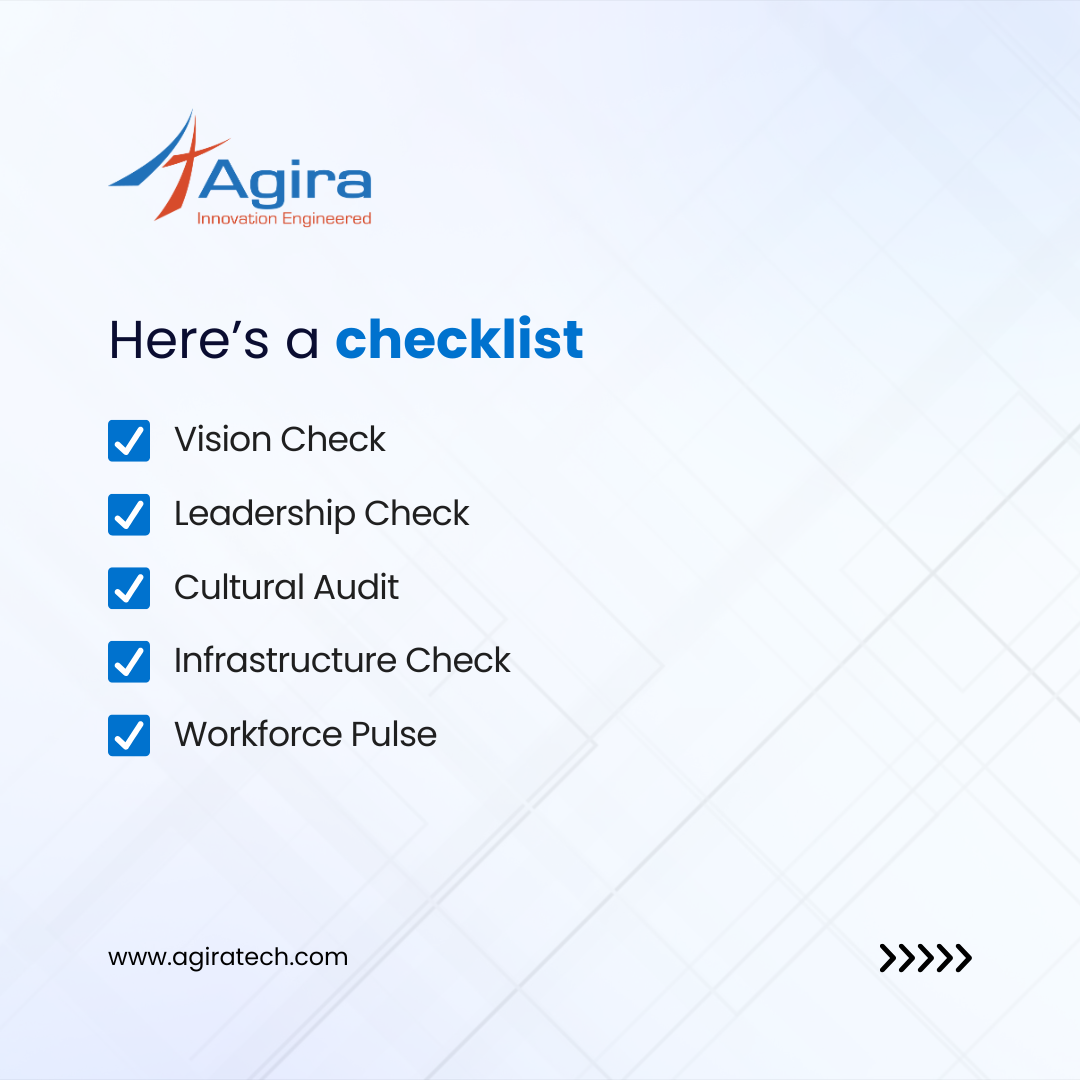
Gauging Vision and Direction Readiness for Business Transformation
Having a clear vision is the ultimatum. Organizations must be aware of where they are and what they need to scale up efficiently. Thus, a strategic roadmap approved by all the stakeholders of the business will lead to a seamless digital transformation.
The answerable questions can be:
- Does the envisioned digital strategy align with the business goals?
- Is the outcome determined from the adopted digital transformation journey?
- Is the transformation journey being benchmarked against the marketing standards?
Thus, having a clear vision is the first step in checking your readiness for business transformation. Without understanding the market, there will be a lag in what is needed to reach the industry benchmark. And without the former, there will be no goal. Thus, as a clear market study, led by a clear analysis on the missing portion and a stable vision developed from the analysis, is all to start off with.
Evaluating Executive Readiness for Business Transformation
The leadership panel, moreover, all the stakeholders must have a clear vision of what the organization is trying to achieve by adopting the readiness for business transformation. It’s not about just being known but about offering the mindset and accountability
Consider:
- Do the executives now have a clear agenda of what they are supposed to do to achieve that unified goal?
- Are they ready to embrace change by adopting the recent tech in the market?
- Do they have a clear understanding of the value of the adoption of recent technology in the market?
Thus, they must lead the organization to adopt the changes positively and not consider it as a burden. The readiness for business transformation is about the entire team working together, but more importantly, it starts with what the leadership panel is projecting to the organization.
Measuring Organizational Culture Readiness for Business Transformation
The readiness for business transformation is about determining the culture that the organization has for it to thrive or fail the process. Thus, an organization’s values, behaviors, and openness offer frictionless momentum
Questions to explore include:
- Are the team-level experiments encouraged or penalized? Because new tries give better outcomes,
- How are organizations responding to failure? Optimistic with contingencies?
- Are employees encouraged for their innovation and efforts?
Thus, they must lead the organization to adopt the changes positively and not consider it as a burden. The readiness for business transformation is about the entire team working together, but more importantly, it starts with what the leadership panel is projecting to the organization.
Assessing Infrastructure and Tooling Readiness
Analyze your existing digital infrastructure. Legacy systems, data silos, and incompatible tools can cripple even the best strategies.
Evaluate:
- The change is constant. So, measure if the systems are scalable and can easily adapt to any change?
- Security plays a major role. It is necessary to ensure that the organization has a robust cloud, data, and security infrastructure.
- Do the necessary tools encourage collaboration, automation, and security?
The readiness for business transformation also includes identifying the effectiveness of the vendor partnerships and the end-to-end integration platforms they offer, and most importantly, their ability to seamlessly integrate with your changing digital value
Determining Workforce Readiness for the Digital Shift
The heart of the readiness for business transformation is the people of the organization. Therefore, it is necessary to understand their skills, attitude, and the capacity for change
Key considerations:
- Do your employees own the latest digital competencies?
- Are they ready to reskill and upskill?
- Are there effective communication strategies between teams?
Above the upskilling process, it is necessary to know how much value this transformation offers to the employees. Analyze their perception, and it is necessary to explain how this transformation plays a huge role in their self-development process

Practical Steps to Gauge Readiness
Thus, we have seen what the areas are to have a look at to check the readiness for business transformation. Dialing them and making it ready will eliminate the need for revisiting them, so that the ongoing process wouldn’t be disrupted. Now the next step is to take actionable steps to assess them
- Conduct a Readiness Assessment Survey: Draft a structured framework that outlines the decided activities and gather feedback from the executives, managers, and frontline employees. Give the questionnaire for the leadership, culture, tech, workforce, and operations team.
- Facilitate Workshops and Interviews: Sessions that offer the space for people to open up and talk about the new digital transformation, and conducting workshops to upskill or solve their queries are necessary.
- Audit Your Digital Infrastructure: Identify how scalable and integration-friendly your current system is. Generate a report and circulate it to system developers for them to make the necessary changes to make it ready for the transformation happening now and in the future.
- Evaluate Skills and Training Needs: Analyze your team’s skills and perform a skill gap analysis. Encourage them to take the upskilling sessions for them to work on the transformed system effectively once it is implemented, rather than upskilling later.
- Engage a Third-Party Consultant: It may be a uneasy situation to asses your own team. That’s why you can hre external consultants like BUSoft Technologies. They can offer an unbiased evaluation and ensure your organization is ready to adopt industry benchmark standards without any blind spots.
- Analyze Change Management Capabilities: See the past transformation protocols and the history. Review the mishaps that happened and the current system state to understand what should and should not be done.
- Score and Prioritize: As seen earlier, there are various sectors and various activities that come into play to adopt the digital transformation journey. So, have a scoring system for the effectiveness and activity tracking module to prioritize tasks.
These activities help you analyze where your organization actually stands and what has to be done to make the foundation apt for the readiness for business transformation.



Using Your Readiness Insights
The assessment is now complete, and you would have made your existing system armed for the readiness for business transformation. Now it’s important to act on the insights and make the transformation a successful one. Here are the steps for it
- Build a Roadmap: As seen earlier, there are various teams and activities involved, so its necessary to have a clear roadmap in place. Many proof of concept (POC) technology initiatives have been left on the shelf, never to be executed, leading to 84% of digital transformation efforts fail.
- Align Leadership: All the stakeholders must be aware of what’s happening with the process, as they have a shared goal and approve the necessary investments.
- Tailor Change Management Plans: It’s not advisable to treat all the teams with the same amount of transformation load. Analyze their existing process, skills, and tailor the transformation plan.
- Track Progress: Establish KPIs for the transformation process alone and evaluate them from time to time
Readiness for business transformation is not a one-time thing. With the advancements happening daily in the tech industry, adoptions are constant. This extensive effort sets the foundation for a defined set of protocols whenever your business goes for a transformation. A promising work and a successful transformation will also instill trust in the stakeholders to offer proper funding to make your organization stay more agile and competitive.
Conclusion
Digital transformation is a multifaceted journey, and success hinges on more than just technology. It requires visionary leadership, an adaptable culture, empowered employees, and resilient operations. By systematically assessing your organization’s readiness from experts like BUSoft Technologies, you lay the groundwork for a transformation that is not only strategic but also sustainable.
Digital evolution is not about perfection, it’s about progression. With the right insights, your organization can move forward confidently, embracing change as a catalyst for growth and innovation.
Author: Mabel